
Welcome to the A Little More, A Little Better Challenge! With Memorial Day 6 weeks away, it's the perfect time to start taking steps to prepare your body for a healthy and happy summer.
As many of you may have experienced in the past, diets and transformational fitness programs that are designed to start and end within a specific period of time ("achieve your best body ever in just 30 days!") often help produce results but those results are not long-lasting. The moment the program ends, and you go back to your old lifestyle and way of eating, most of us gain back the weight we lost plus some. And it's almost impossible not to go back to your old lifestyle and way of eating, because it is really, really difficult to stick with diet rules that require you to go cold turkey off your favorite foods and treats and keep up with a 60+-minute per day, high-intensity workout program, 6 days each week for the rest of your life.
It turns out that science backs up the theory that following simple, healthy habits, consistently over the long term, is the key to living a long, healthy life. In his New York Times Bestseller, The Blue Zones, Dan Buettner traveled the world to study the lifestyles of the longest, healthiest living people, to identify the commonalities between how they lived their lives. None of these individuals had ever visited a gym, or read a diet book, or engaged in a juice cleanse. They simple built healthy habits into their everyday lives for a lifetime.
I first heard the phrase "a little more, a little better" from Precision Nutrition, the sports and exercise nutrition company through which I have my nutrition certification. The concept is that big, lasting change is achieved by building sustainable habits, one by one. As the ancient Chinese philosopher Lao Tzu stated, "a journey of a thousand miles begins with a single step."
Today, you take your first step.
Every week between now and Memorial Day, we will work together to build healthy habits, step by step, in the areas of nutrition, movement and lifestyle. Because a habit is only good if it is something that you will be able to follow long term given your schedule, responsibilities, commitments, finances and preferences, you will largely be selecting the habits yourself, based on (1) what you think are your biggest obstacles to achieving your health goals; (2) what small step you are sure you can successfully take that week to help you overcome your obstacles to move closer to your goals.
The key is to pick a habit that you know with almost certainty you can stick to this week. B.J. Fogg, Stanford professor and PhD, who has spent nearly two decades studying human behavior, suggests that because willpower is like a muscle and can tire quickly, the best way to develop a new habit is to do so in a way that does not require willpower. He recommends that to adopt a new habit, pick the smallest step you can take - "a step so tiny, you think it's ridiculous" - and then choose an existing routine in your life to act as a trigger for the new habit.
For example, if you want to start flossing your teeth, after you brush your teeth at night (your routine - I hope!), start with flossing just one tooth (new habit). Gradually build upon this habit until you have achieved your goal.
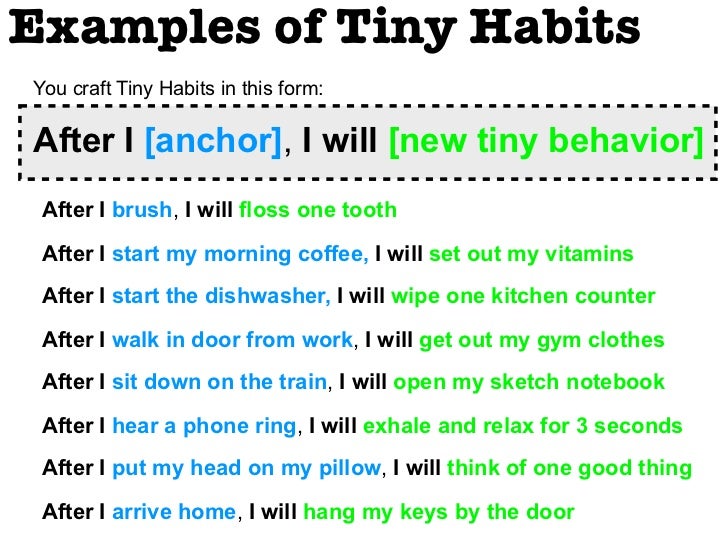
This week, I want you to first identify your goal over the next 6 weeks, and then identify your biggest obstacles to achieving that goal in each of the following areas: (1) nutrition; (2) movement; and (3) lifestyle. Then pick one, tiny step in each of these areas to help you move closer to your goal this week. Remember, the steps should be so small as to be almost ridiculous.
For me, for example, my biggest movement challenge is stretching. I love doing CrossFit, lifting weights, running, and I get plenty of Non-Exercise Activity Thermogenesis (a.k.a., NEAT, or everyday movements other than formal exercise); however, I don't enjoy stretching, and I don't spend much time doing it. So this week, I am committing to doing 3 Sun Salutations first thing in the morning (a yoga sequence). In the language of B.J. Fogg: "After I wake up and get out of bed in the morning, I will immediately do 3 Sun Salutations."

For your lifestyle habit, think of elements of your current daily activities, outside of nutrition and movement, that you feel inhibit your long-term health goals. Maybe your commute makes you stressful (as does mine), or maybe you spend too much time watching TV or surfing the Internet, or maybe you aren't spending as much time as you'd like with friends or family, or maybe you do not listen to music or attend religious services as much as you'd like. Whatever your obstacle, pick a tiny habit that will help you get closer to your goals this week - little by little.
In addition to your 3 tiny habits (one for nutrition, one for movement and one for lifestyle, I also am asking you to start your day off with a glass of water with a slice of lemon in it. The importance of drinking water is one of the few undisputed facts in nutrition science, and adding a lemon provides additional detoxifying benefits. Finally, there is no better way to break your overnight hydration fast than with water.
I like to slice of a lemon over the weekend and keep the slices in a baggy in the refrigerator. Every morning, after I wake up, I go down into the kitchen and pull out a slice a lemon and pour a glass of water and drink it while I get ready for work. "After I wake up and get out of bed in the morning, I will go into the kitchen and pour a glass of lemon water."
One great way of viewing your progress is to post a paper calendar in a prominent place - such as on your bathroom mirror or your refrigerator - and put a big checkmark on each day in which you stuck with your habits. Because this process is about progress, not perfection, aim to do just a little more, a little better every week, which may mean only sticking with your habits one or two days during the first week and three days next week.
Over the course of the next 6 weeks, we will be adding new, tiny habits every week. If you follow this Challenge throughout, that means that you'll have taken 24 steps (4 habits a week for 6 weeks) towards your health goals. Over the course of a year, that would equal over 200 new habits. And that's a lot of change.
Good luck, and let me know if you have any questions or need help identifying your obstacles or your tiny habits.
Until next time,
Kathleen
